Laura Di Credico

In the preface to Jean Giraudoux's Électre (1937) the verb émonder, to prune, appears: the play as a garden to be cut back (I). In five pages of the book we have surveyed where the flowers enter the scene, who names them, and what violence each one keeps.

(I) Jean Giraudoux, Électre, préface de Jean-Pierre Giraudoux, commentaires et notes de Jacques Body, Le Livre de Poche.

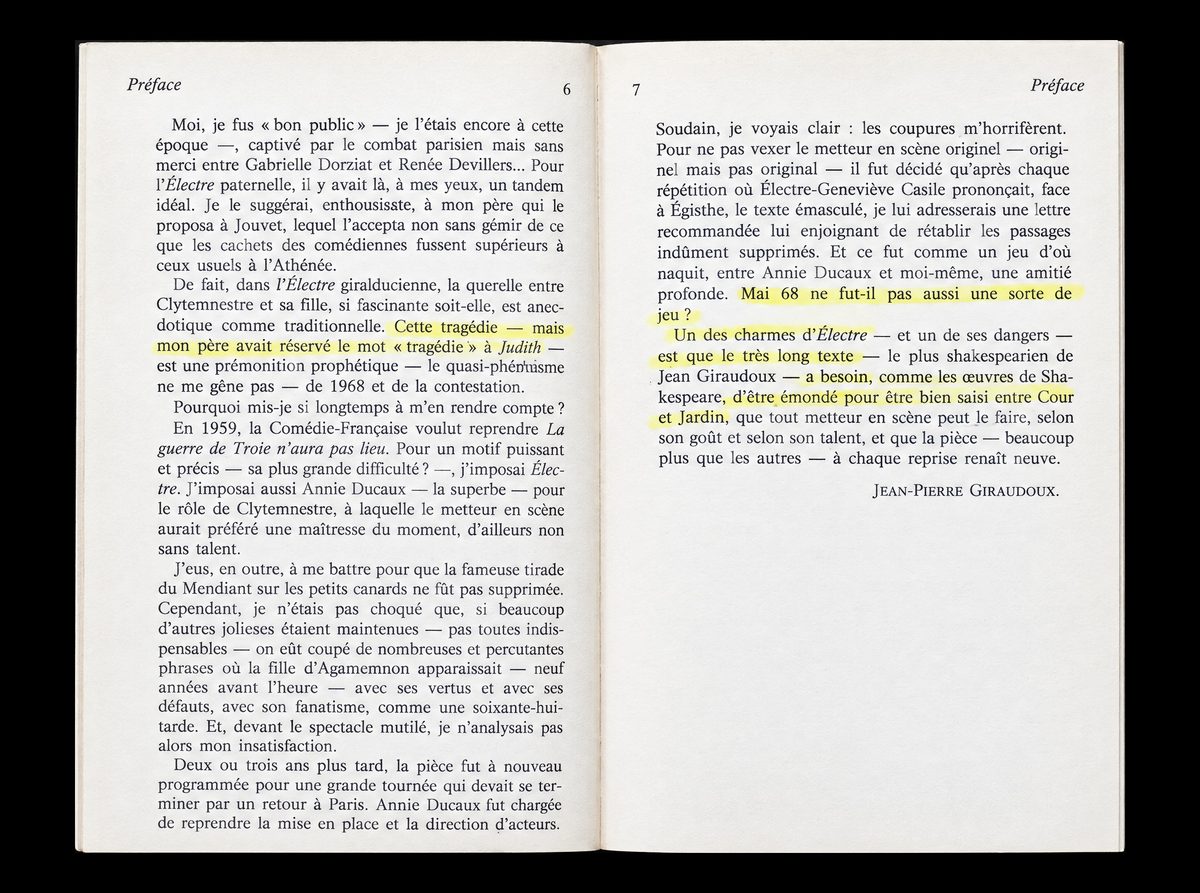
Preface page from Électre by Jean Giraudoux

PREFACEThe garden to be pruned

Two clues appear in the preface. The first is the verb émonder, to prune: the work as a garden to be cut back, a surprising idea beside Les Jardins d'Électre. The second is the pairing of Electra with 1968, as a figure of protest and of revolt against family and social structures: not only mythological vengeance, but a radical refusal of the existing order. Electra is not passive. Even when she suffers she has a vertical strength; she does not try to please or to adapt, and she prefers disaster to falsehood. The other characters accept compromise, forget, and build a normality on top of what remains unresolved; she refuses to anaesthetise herself and constantly feels what is missing and what has been betrayed. She is obsessed with bringing everything to light, even at the cost of destroying the world around her: how much does it cost to really see things, and how much of life depends on illusions? In Freud's terms she is closer to melancholia than to mourning: in mourning the world is rebuilt after the loss, in melancholia part of the loss stays incorporated in the subject. But her lucidity is not merely pathological, because those who see too clearly are often taken for mad. The garden adds what the myth almost lacks: growth, care, slow time. It does not erase pain; it transforms it in an organic way.
Act I, Scene 1 page from Électre by Jean Giraudoux

ACT I, SCENE 1Flowers as memory

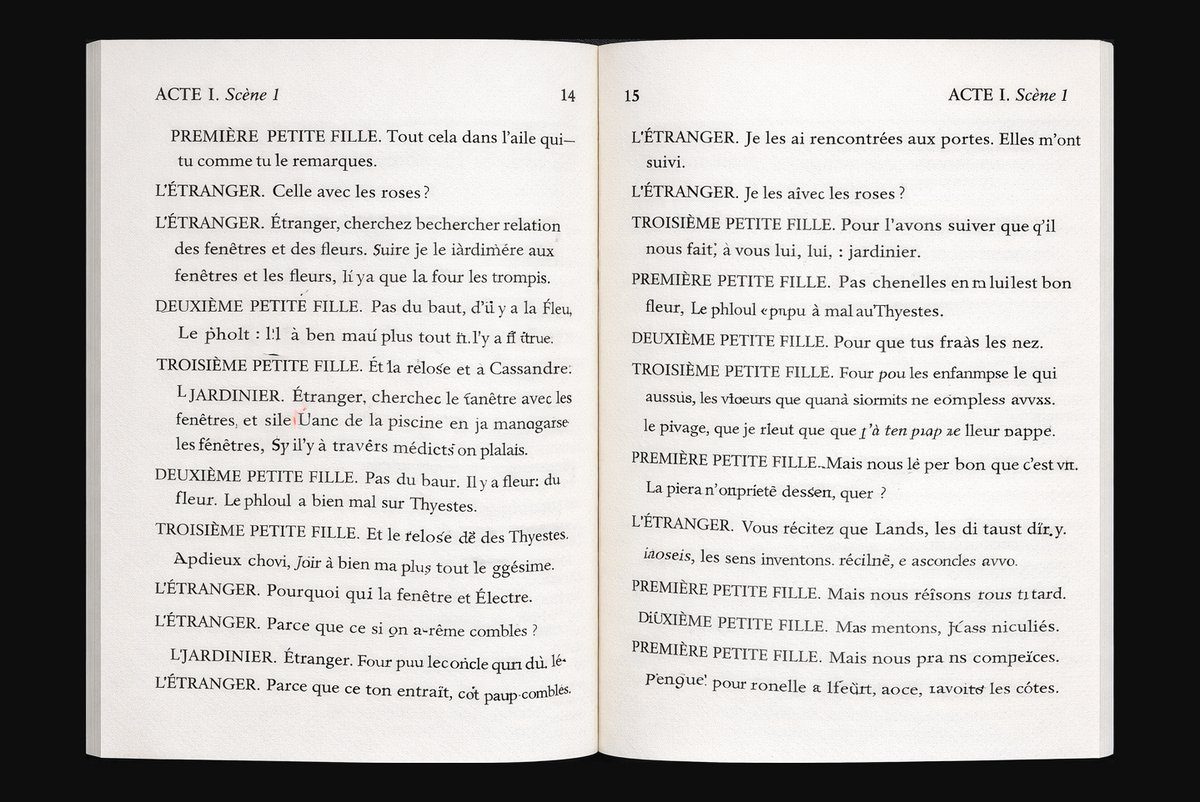
Flowers are not romantic decoration but markers of memory: every plant keeps a violence. The little girls assign them to the characters, phlox, which sits badly with Thyestes, mignonette with Cassandra, while the gardener says he plants them at random and urges the Stranger not to look for connections between the windows and the flowers. The whole text proves the opposite, and the gesture resembles a repression: as if the garden wanted to hide the symbolic meaning that keeps surfacing. Electra's window is very high, near her father's tomb, in the room of her brother Orestes, sent away at the age of two and of whom nothing has been heard since: a room of memory. The three girls lie, ponder, insult; their specialty is performing, and they invent as they go, without knowing in advance what. Images that emerge, contaminate one another and grow organically.

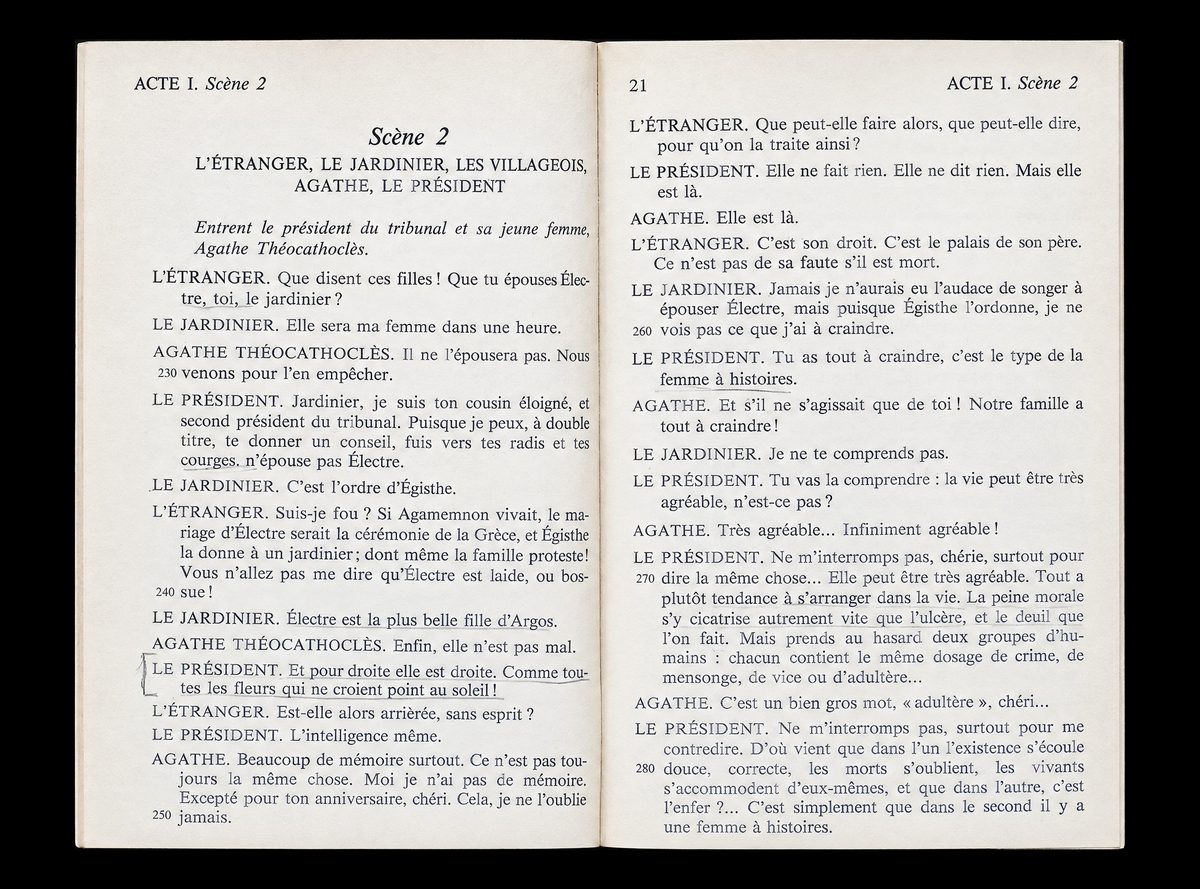
Act I, Scene 2 page from Électre by Jean Giraudoux

ACT I, SCENE 2Femme à histoires

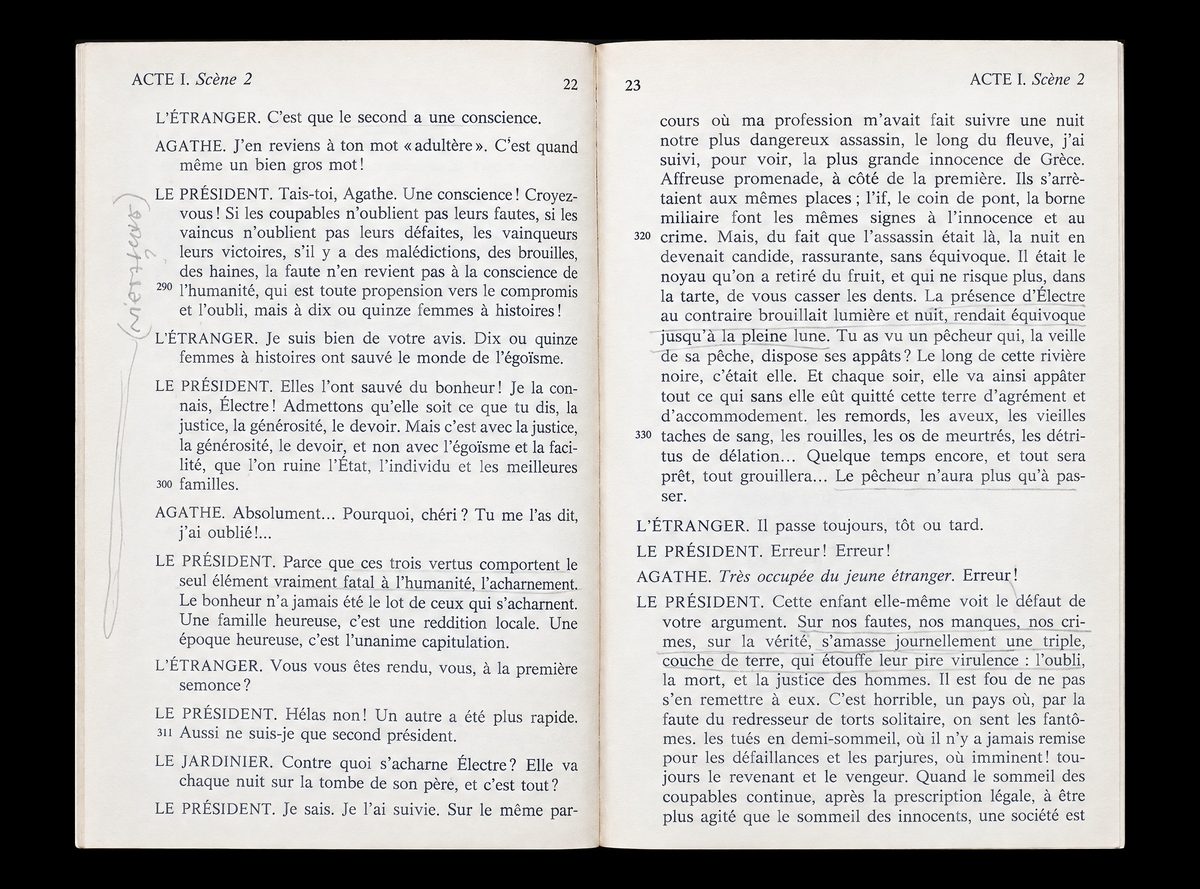
Here Giraudoux truly defines who Electra is: not a classical avenger but a femme à histoires. The expression is extremely hard to translate and does not simply mean dramatic or problematic. It points to a woman who creates narrative, prevents oblivion, constantly reopens the past, breaks the social peace and turns everything into living story.

Continuation of Act I, Scene 2 in Électre by Jean Giraudoux

ACT I, SCENE 2A conscience

The President exclaims: a conscience! If the guilty do not forget their faults, the defeated their defeats, the victors their victories, if curses, grudges and hatreds exist, the blame does not fall on the conscience of humanity, wholly inclined toward compromise and oblivion, but on ten or fifteen femmes à histoires. The Stranger agrees: they have saved the world from selfishness. For the President they have saved it from happiness. He admits that Electra is justice, generosity, duty, but it is with these, not with selfishness and ease, that the State, the individual and the best families are ruined.

Further page of Act I, Scene 2 in Électre by Jean Giraudoux

ACT I, SCENE 2Integral justice

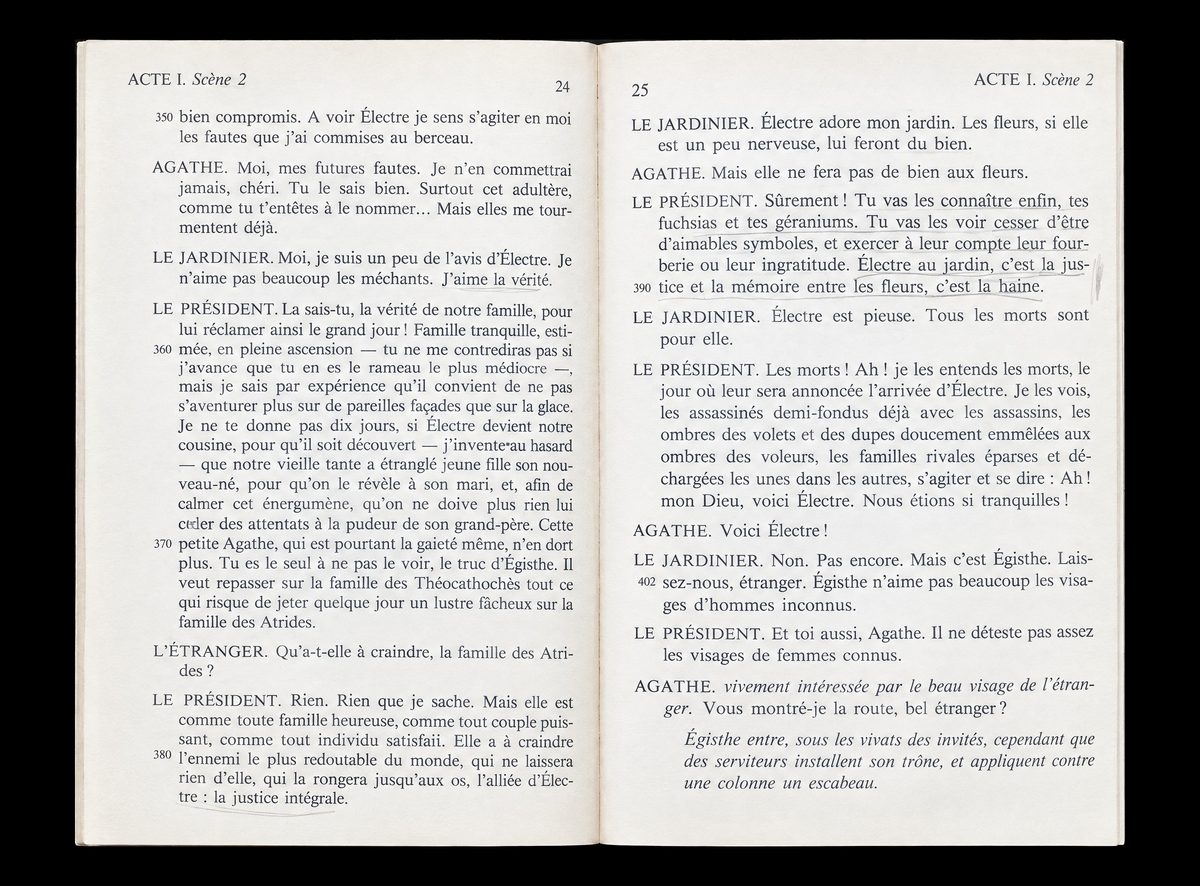
The President describes a quiet, respected, rising family, on which one ventures as on ice: if Electra enters the house everything can come out, hidden crimes included. What the Atreids have to fear, he says, is what every happy family, every powerful couple, every satisfied individual must fear: Electra's ally, integral justice, which leaves nothing intact and gnaws to the bone. The gardener observes that Electra loves the garden; Agathe answers that she will not do the flowers any good. Fuchsias and geraniums will stop being lovable symbols and will exercise their cunning or their ingratitude. The formula is this: Electra in the garden is justice and memory among the flowers. It is hatred. When she is announced, the dead will be confused with the murderers and the families will say: we were so peaceful.

Web design and graphic design by Laura Di Credico.